
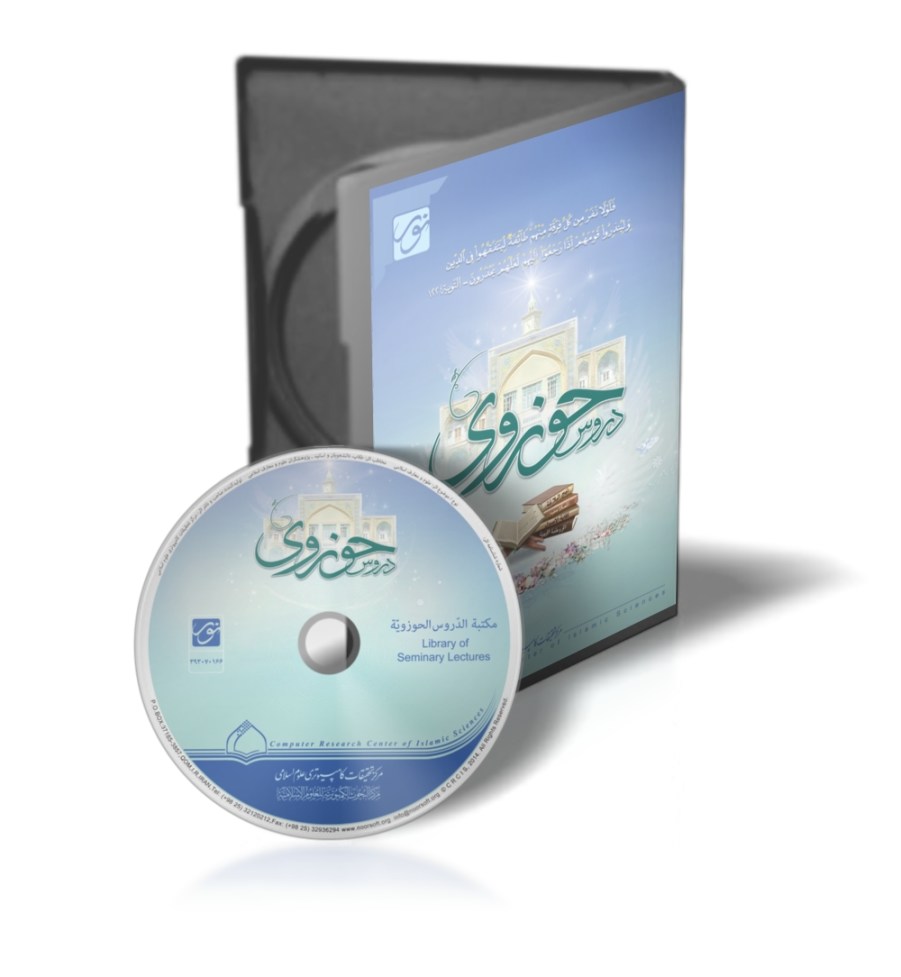

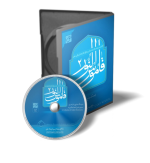
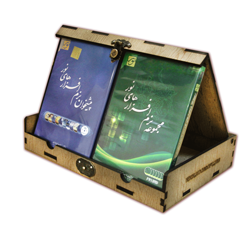
About Library of Seminary Courses
"Allah will raise those who have believed among you and those who were given knowledge, by degrees." [1]
"A man of heart came to the school from the monastery, breaking the covenant of companionship with the people of the path.
I asked: What is the difference between the scholar and the worshipper that you chose this group over that?
He said: That one saves himself from the waves, while this one strives to save the drowning." [2]
"Listen, O brother, to my advice with your soul and heart, and embark upon the knowledge of religion with diligence,
For the scholar attained mastery over the two worlds; even if he were younger, the elders found leadership through him." [3]
Praise be to God, the All-Knowing and All-Powerful, who placed the jewel of the spirit in the shell of the human body, lit the lamp of intellect in the sanctuary of their existence, and inscribed upon the tablet of their nature the lesson of monotheism and devotion. Then He sent His Messengers with "Epistles" from Himself to them, to read aloud to them in detail from "beginning" to "end" what He had written with the pen of creation in the book of their fitrah (innate nature), and to remind them with a firm "logic" of the "philosophy" of creation, wiping the dust of neglect from the mirror of their souls, so that they might articulate what lies hidden within.
And perpetual blessings of heart and tongue be upon the greatest Teacher of humanity, the Seal of the Prophets, the deliverer of the final, most complete, and most beautiful letter from the Creator to mankind; a letter in which the "Principles" and "Rules" of fitrah were "edited" in such a "grammar" that it remains forever safe from the harm of distortion and "conjugation." And peace be upon his pure Household, for whoever enters the "Seminary" (Hawza) of their Guardianship and aligns their "objectives" and "gains" with their command, exits the dominion of the Taghut (tyrant) and sits at the "level" of the angels, nay, higher than them. What more can I say about those "men" of "competence," whose following leads the intellect in "insight" to its "ultimate" end, and draws the heart in guidance to the threshold of the Infinite?
The Necessity and Objective of the Program
Speaking of the value of religious knowledge and the status of its teacher and learner, and recalling and recounting these blessings, is both gratitude to the Bestower of blessings and a wiping away of the dust of neglect from the soul and heart. Here is a little of that abundance:
1. "Only those of His servants who possess knowledge fear Allah." [4]
2. "The angels lower their wings in submission to the seeker of knowledge, pleased with what he does. Indeed, the inhabitants of the heavens and the earth, even the fish in the depths of the sea, seek forgiveness for the scholar." [5]
3. "One jurist (Faqih) is harder upon Iblis than a thousand worshippers." [6]
4. "The jurists are the trustees of the Messenger." [7]
5. "If people knew what lies in knowledge, they would seek it even by shedding blood and plunging into the depths of seas." [8]
6. "Whoever leaves his home seeking a gate of knowledge, Allah records for him with every step the reward of a martyr from the martyrs of Badr." [9]
7. "On the Day of Resurrection, the ink of the scholars will be weighed against the blood of the martyrs, and the ink of the scholars will outweigh the blood of the martyrs." [10]
8. "More orphaned than the child who has lost his father is the orphan who has been cut off from his Imam, unable to reach him and ignorant of his rulings in the trials of his religion's laws. Beware! Whoever from our Shia is a scholar knowledgeable in our sciences, and takes this ignorant one, cut off from our presence and orphaned in his lap, guides him, directs him, and teaches him our Sharia, he shall be with us in the Highest Companion (Paradise) among the gathering of Prophets." [11]
Note:
The subject of all these praises and honors from the Creator and creation are the scholars and students who have entrusted the reins of their selves to intellect, and whose primary concern, above all else, is preserving faith and obeying the command of God Almighty. They are not those whom severe fanaticism has blinded, whose intellects have been abandoned, who have let go of the reins of the self, preferred the debris of this world over the station of the Hereafter, and whose sole thought is securing their livelihood and pleasing their followers. For these, in the words of Imam Hasan al-Askari (AS), are more harmful to the weak of the Shia than the army of Yazid (may Allah's curse be upon him) was to Imam Hussein (AS) and his companions; for that vile army took people's lives and livelihoods, while these take their religion and faith. [12]
"That is not knowledge which inclines toward the world *** It has a form but lacks meaning.
Knowledge never combines with greed *** If you desire sovereignty, banish the dog from yourself.
Religious sciences are of angelic character *** They do not enter a heart bred with a dog.
The final hadith of Mustafa is this *** Hear it well, for it is indeed so:
If there is an image in a house *** Angels will not enter it of necessity.
Go and wipe the face of the heart's tablet *** So that angels may make their home before you.
Learn from him the science of inheritance *** And cultivate for the Hereafter." [13]
The Special Importance and Status of the Quran in Hawza Lessons
It is worth noting that in this program, efforts have been made to offer diverse and numerous books related to the Quran, including recitation, tajweed, translation, exegesis, and Quranic sciences. This is because honorable professors and dear students are well aware that, unfortunately, for years the axis of the Hawza curriculum has not been the Quran. So much shouting, noise, and "saying and saying" has arisen from here and there that the gentle call of the Quran has been diminished. Now our hope rests upon the men of determination and Quranic knowledge within the Hawza, and we wish that they turn this mill on its primary axis, lower the voices, so that the call of the Quran may be heard. For they know well that: "No one deviates from the Quran except to the Fire," [14] so let them devise a new plan and raise the banner of truth that the Greatest Messenger (PBUH) placed among us, so that we neither fall behind it nor go beyond it, but rather, in its light, rescue our souls from the darkness of neglect. For: "Whoever advances beyond it perishes, whoever lags behind it perishes, and whoever adheres to it attains." [15] Surely, the great figures of the Hawza will never allow students to meet God while His Messenger raises his hand to His throne in complaint, saying: "My Lord, indeed my people have taken this Quran as [something] abandoned." [16]
Hear the cry of the compassionate, pained hearts who have felt with their entire being the pain of the Hawza lessons' lack of affection for the Quran:
A) Imam Khomeini (RA):
"O Hawzas of knowledge and universities of research! Arise and save the Holy Quran from the evil of ignorant ascetics and reckless scholars who attack and continue to attack the Quran and Islam with knowledge and intent. I say this seriously, not as a mere courtesy: I regret my life wasted in the path of error and ignorance. And you, O brave sons of Islam! Awaken the Hawzas and universities to [the lack of] attention to the affairs of the Quran and its various dimensions. Make the teaching of the Quran in every branch your focus and supreme goal. Do not, God forbid, at the end of life when the weakness of old age attacks you, regret your deeds and mourn the days of youth, like the writer." [17]
B) The Supreme Leader (May his shade endure):
"I have mentioned this point many times in our gatherings: Unfortunately, the Quran has no place in our educational system; that is, in the Hawza system, there is no lesson among our official lessons that depends on referring to the Quran and Hadith. If you study Arabic literature, Sath (intermediate levels), or Dars al-Kharij (advanced jurisprudence), it does not happen that to understand a lesson issue you need to stand up, take the Quran, open it, and find a verse. Our educational system simply does not need the Quran; it is designed independently and separately from it." [18]
"Becoming a Mujtahid has not depended on understanding the Quran or referring to it. How many verses of the Quran were in the issues of Usul and Fiqh that were used as evidence? From beginning to end, perhaps only a few hundred verses that existed in books and everywhere." [19]
"A student, a jurist, to research an issue, needs a dictionary, so he stands up and takes the dictionary. It frequently happens that he needs the book 'Wasa'il' or a book of Hadith or Hadith collections, so he stands up and takes them. But how often does it happen that a student, to reach a jurisprudential or principled issue, is forced to stand up from his place, take the Quran, search, find a few verses, and refer to them?" [20]
"In the Hawza, there was a lesson in Tafsir; probably there still is. But the lesson in Tafsir was not an official lesson of the Hawza, and no one would say that someone who did not attend Tafsir class is ignorant. However, if someone did not attend Fiqh class, he was considered ignorant. This was in the past; it is also so after the Revolution." [21]
"I still consider familiarity with the Quran in the Hawzas to be weak, like in the past; of course, the past was weaker, but now it is still weak. Students must become familiar with the Quran." [22]
"Most Sunni scholars have greater familiarity with the Quran." [23]
"I have said this many times: Our student, from the day he says 'Bada'an Ayyadaka Allah' until the day he becomes a Mujtahid, may not find it necessary even once in his academic path to stand up from the edge of the shelf, take the Quran, and open it." [24]
C) Allamah Tabataba'i (RA):
"If you reflect on these sciences, you will see that they are organized in such a way that it appears they have no need for the Quran at all. It is even possible for a student to learn all those sciences, become a specialist in morphology, syntax, rhetoric, language, Hadith, Rijal, Dirayah, Fiqh, and Usul, read all these lessons to the end, become a champion in these sciences, and even reach the level of Ijtihad, yet be unable to recite the Quran as it should be, or in other words, never have touched any Quran at all. Thus, it becomes clear that from this perspective, there is no relationship between those sciences and the Quran. In truth, people have no duty towards the Quran except recitation, and God forbid, the Quran has no value other than being read or hung around a baby's neck to protect it from misfortunes. So, you dear reader, if you are among this type of Muslims, take heed and reconsider your treatment of the Quran." [25]
D) Martyr Murtaza Mutahhari (RA):
"It is strange that in the most sensitive points of our religion, if someone spends their life on the Quran, they face a thousand hardships and difficulties; they lose bread, life, personality, respect, everything. But if they spend their life on books like 'Al-Kifayah', they gain everything. Consequently, thousands are found who know 'Al-Kifayah' inside out; they know it, they know its refutation, they know the refutation of its refutation, they know the refutation of the refutation of its refutation, but two people cannot be found who truly know the Quran!!! If anyone is asked about a verse of the Quran, they say: One must refer to the commentaries. Even stranger is that this generation, which has treated the Quran this way, expects the new generation to read the Quran, understand it, and act upon it!" [26]
"The primary and fundamental source of religion, faith, and thought for a Muslim, and that which gives heat, meaning, sanctity, and spirit to his life, is the Quran." [27]
"Utilizing any other source depends on prior knowledge of the Quran. The Quran is the scale and criterion for all other sources. We must measure Hadith and Sunnah by the criterion of the Quran; if it agrees with the Quran, we accept it, otherwise not." [28]
"I wish someone would appear and acquaint me with the world of the Quran as well." [29]
Subject and Scope of the Program
By "Hawza Lessons," we mean all the books that a seminary student must study from the beginning of their education until the end of the "Sath" (Intermediate) level, in the fields of: Arabic Literature, Logic, Principles of Jurisprudence (Usul al-Fiqh), Jurisprudence (Fiqh), Theology (Kalam), Wisdom (Hikmah), Hadith, Nahj al-Balagha, and the Quran. However, it should be noted that the books included in this program are not limited to the aforementioned curricular texts; rather, they also encompass some commentaries (Shuruh), marginal notes (Hawashi), and translations of those texts. Furthermore, the program includes many books closely related to Hawza texts, which can assist professors and students in analyzing, clarifying, and elaborating on the difficulties, ambiguities, and concise points within the mentioned texts, thereby broadening their horizons and deepening their perspective on the subject under discussion.
Target Audience of the Program
Honorable students and professors of Islamic Seminaries (Hawzas) ranging from the introductory level to the end of the intermediate level (Sath), as well as university students and esteemed researchers interested in Islamic sciences and Hawza lessons.
Note:
Given the necessity of respecting the intellectual property rights of the sources used in the program, some titles have been excluded due to the inability to obtain permission from the copyright holders. We hope, God willing, to pursue increasing the number of sources in the future with greater capabilities.
General Capabilities of the Program
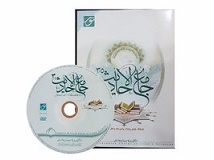
· The complete text of 230 book titles in 785 volumes in Arabic and Persian, covering topics: Arabic Literature, Quran, Nahj al-Balagha, Logic, Fiqh, Usul al-Fiqh, Kalam, Hadith, Wisdom and Philosophy, Ethics and Mysticism.
· Categorization of books based on topics.
· Page-by-page linking of Arabic literature texts with images of the books.
· Linking translation, commentary, and marginal notes with the text.
· Access to verses contained in the program's texts along with related content.
· Connection of text vocabulary to the program's dictionaries.
· Search in various ways within words and phrases of the text and book indexes.
· Thematic search in titles and headings via a selective index.
· The complete text of the Holy Quran with Persian translation and search capability within verses.
· Linking the text and index of books with other program sections, such as: Display, Search, Quran, or Bibliography.
· Research capabilities accompanied by the ability to take notes, save, edit, and print text.
Footnotes:
[1]. Al-Mujadila: 11.
[2]. Saadi, Golestan, Chapter 2: On the Morals of Dervishes, Story 37.
[3]. Sheikh Mahmoud Shabistari, Gulshan-e Raz, p. 63, Cultural Services Publications, Kerman, 2003 AD.
[4]. Fatir: 28.
[5]. The Messenger of Allah (PBUH) said: "...Indeed, the angels lower their wings for the seeker of knowledge, pleased with what he does. Indeed, whoever is in the heavens and whoever is on the earth seeks forgiveness for the seeker of knowledge, even the fish in the sea..." (Majlisi, Muhammad Baqir, Bihar al-Anwar, Vol. 1, p. 164, Publisher: Dar Ihya al-Turath al-Arabi, Year: 1403 AH).
[6]. The Prophet (PBUH) said: "One jurist is harder upon Iblis than a thousand worshippers" (Ibid., p. 177).
[7]. And he (PBUH) said: "The jurists are the trustees of the Messenger" (Ibid.).
[8]. Imam al-Sadiq (AS) said: "If people knew what lies in knowledge, they would seek it even by shedding blood and plunging into the depths" (Ibid., p. 177).
[9]. The Messenger of Allah (PBUH) said: "Whoever leaves his home seeking a gate of knowledge, Allah records for him with every step the reward of a martyr from the martyrs of Badr..." (Ibid., p. 178).
[10]. The Messenger of Allah (PBUH) said: "On the Day of Resurrection, the ink of the scholars will be weighed against the blood of the martyrs, and the ink of the scholars will outweigh the blood of the martyrs" (Ibid., p. 16).
[11]. From the Messenger of Allah (PBUH) that he said: "More orphaned than the child who has lost his father is the orphan who has been cut off from his Imam... Whoever from our Shia is a scholar... and teaches him our Sharia, he shall be with us in the Highest Companion" (Ibid., Vol. 2, p. 3).
[12]. Majlisi, Muhammad Baqir, Bihar al-Anwar, Vol. 2, pp. 87-88.
[13]. Sheikh Mahmoud Shabistari, Gulshan-e Raz, p. 64.
[14]. "From Abu Abdullah (AS) who said: The Messenger of Allah (PBUH) said: 'The Quran is guidance from misguidance, clarification from blindness, recovery from stumbling, light from darkness, illumination from graves, protection from destruction, right guidance from error, clarification from trials, and conveyance from this world to the next. In it is the perfection of your religion. No one deviates from the Quran except to the Fire'" (Fayd Kashani, Mulla Muhsin, Tafsir al-Safi, Vol. 1, p. 16).
[15]. (Nahj al-Balagha, Sermon 100).
[16]. Al-Furqan: 30.
[17]. (Sahifeh Imam, Vol. 20, p. 93).
[18]. (The Hawza and Clergy in the Mirror of the Supreme Leader's Guidelines, Vol. 2, p. 324).
[19]. Ibid., p. 326.
[20]. Ibid., p. 327.
[21]. Ibid.
[22]. Ibid., p. 313.
[23]. Ibid., p. 319.
[24]. Ibid., p. 323.
[25]. Translation of Tafsir al-Mizan (20 volumes), Vol. 5, p. 450.
[26]. Collected Works of Martyr Mutahhari, Vol. 24, p. 534.
[27]. Collected Works of Martyr Mutahhari, Vol. 26, p. 25.
[28]. Collected Works of Martyr Mutahhari, Vol. 26, p. 26.
[29]. Collected Works of Martyr Mutahhari, Vol. 16, p. 346.



Share your thoughts with other customers