

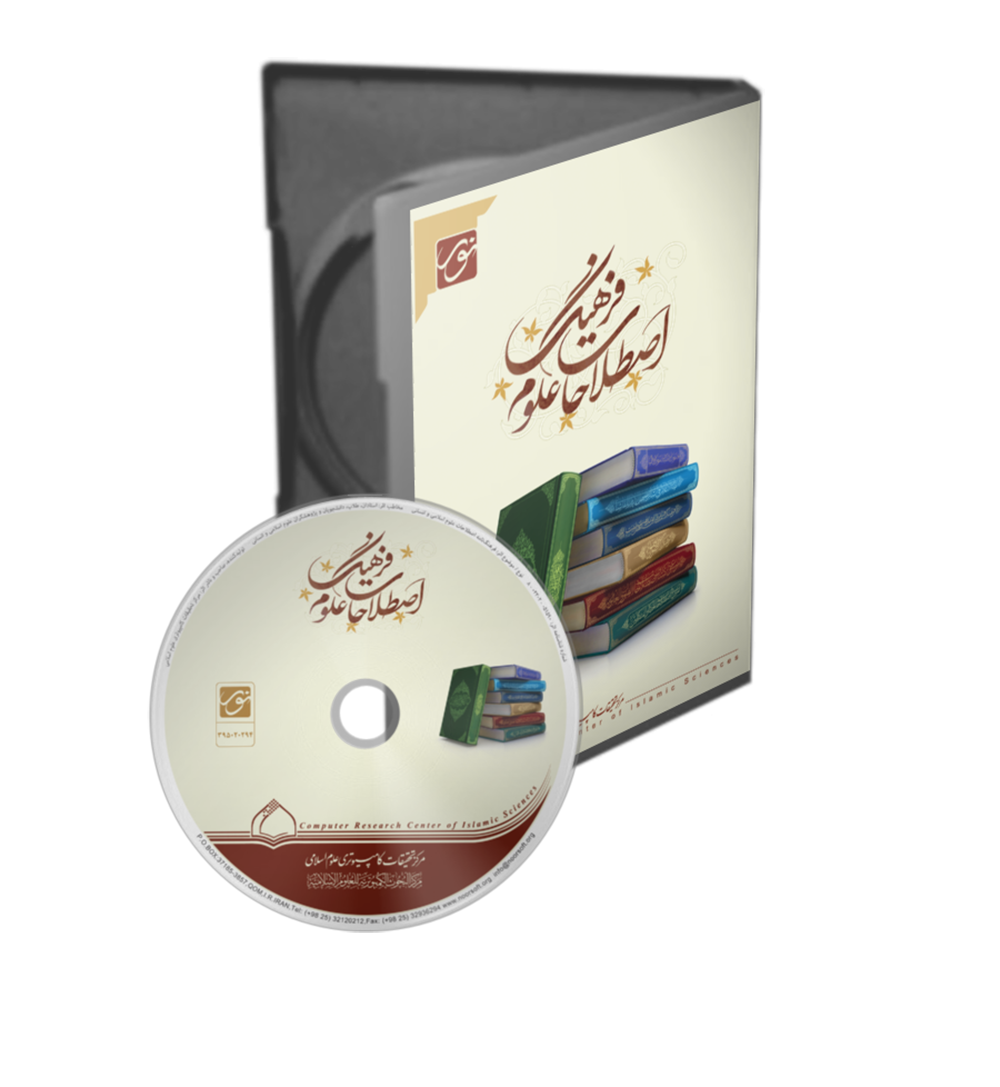
About Glossary of Technical Terms
"Terminology Dictionary of Sciences" is a program containing works that explain specific terms in each field of Islamic and human sciences. This type of work can today be called "Topical Dictionaries," written under titles such as "Al-Mustalahat," "Istilahat," "Farhang-e Istilahat," "Mu'jam al-Mustalahat," "Farhang-nameh," "Vazheh-shenasi-ye Istilahat," "Vazheh-nameh," etc. Examples of terminology dictionaries include: "Mustalahat al-Fiqh," "Mu'jam al-Mustalahat wa al-Alfaz al-Fiqhiyyah," "Istilahat al-Usul wa Ma'zam Abhatha," "Farhang-e Istilahat-e Mantiqi," and "Farhang-e Istilahat-e Falsafeh va Kalam-e Islami." These sources are considered primary reference materials.
Reference Sources
There are various definitions for reference books. Rangarathan believes that a reference is a book designed in a way that allows searching for specific information within it. He argues that reference books are not used for continuous reading (Alijani & Karami, 1388 SH, p. 36). Instead of presenting an idea sequentially like other books, reference books offer authentic information to readers in the form of short entries arranged alphabetically or systematically (Ibid., pp. 38-39).
Reference sources are considered essential tools for conducting research in various sciences; without them, researchers would be forced to spend significant time and money gathering primary research materials. Reference sources, by providing documented and certain information about various terms and words, gather everything that needs to be said about a term in one place. What increases the importance of reference sources for researchers is their reliance on primary sources and their avoidance of the personal opinions of entry authors. Some library science experts believe that reference books in humanities research are akin to research tools in experimental science laboratories; just as a physics researcher must first become familiar with laboratory tools and learn how to use them, a humanities researcher must also become familiar with research tools and their usage (Setoudeh, 1373 SH, p. 15).
Reference sources are generally divided into two categories:
1. Primary or first-rank reference sources, which directly provide an answer to the user's question; such as encyclopedias.
2. Secondary or second-rank sources, which instead of directly answering individuals' questions, refer them to other sources; such as indexes, abstracts, etc. (Ibid., p. 28).
Terminology, or Terminology Dictionary, or "Farhang-e Istilahat-e Olum," is a type of reference source with a special status among them; because it covers specialized fields of science, and its main audience is not general users, but rather students and specialized researchers in various scientific fields. Its definition and details will be discussed below.
Terminology Dictionary of Sciences
In the past, the term "Farhang" (Culture/Dictionary) referred to the collection of sciences, knowledge, and everything that causes the elevation of the spirit and the training of the soul. Today, it is still used in this sense in words like "Farhangestan" (Academy) and "Ministry of Culture," etc. (Bostani, 1338 SH, pp. 95-96).
Therefore, "Farhang" refers to the collection of sciences, knowledge, and arts of a people, or a book containing the words of one or more languages and their explanations.
Types of Dictionaries
A) Word Dictionaries;
B) Terminological, Topical, and Specialized Dictionaries;
C) Colloquial Dictionaries;
D) Multilingual Dictionaries;
The term "Istilah" (Term) refers to a word or compound words that have acquired a specific meaning in a particular science or sciences, distinct from their general meaning.
Scholars of every science use terms (i.e., words borrowed from general usage and employed in their own common usage with the intended meaning) to express concepts. Over time, as terms multiply and are transmitted to subsequent generations, creating a common language among the community of scholars in a specific science, the need arises to write and compile a terminology dictionary.
A terminology dictionary is the explanation and definition of a set of words that have acquired a specific semantic load in sciences and among followers of a specific school of thought. According to the aforementioned definition of reference source types, a terminology dictionary is considered a primary reference source (Nouri, 1377 SH, p. 90).
Difference between Terminology Dictionary and Lexicon/Word Dictionary
At least four categories of differences can be identified between a terminology dictionary and a lexicon:
A) "Istilah" means the agreement of a specific group of people to coin or use a word in a sense other than its original meaning. Every field, in its evolutionary path, is a breeding ground for specific terms. "Terms are in fact indicators and indices that represent a general and abstract concept within a linguistic form. Every word carries a burden of meaning and conveys that general meaning to the audience, but indices, in addition to the general meaning, express general and abstract concepts specific to experts" (Setoudeh, 1373 SH, p. 62).
"Lughat" (Word), according to some linguists, is derived from the Greek "Logos," meaning words common among all speakers of a people (general usage).
B) "Another difference between a word and a term lies in the semantic scope. A word in a lexicon has a limited semantic scope, usually consisting of one or a few words placed opposite it; however, the semantic scope of a term is broader and wider. For example, the word 'Salah' (prayer) in language means supplication. But when this same word is taken from general usage and used as a term in a specific context, it acquires a broad meaning, referring to a series of actions that must be performed with specific etiquette and conditions to fulfill an obligation" (Ibid., p. 63).
C) Another difference is that the number of words in the vocabulary of a language is limited in terms of lexemes and can be presented in a collection called a dictionary, but for terms, no limit is conceivable due to the emergence of new phenomena.
D) The usage of a word and a term is inverse; meaning the scope of usage of a word in general usage is approximately the number of all speakers of that language, but the scope of usage of a term and the number of individuals familiar with its terminological meaning is more limited and fewer than the scope of usage of a word. For example, the word "Salik" in language means a walker or traveler, but in the terminology of mystics, it refers to one who steps from the self towards the Truth, seeking proximity to Allah, fearing no difficulties on this path, and advancing with the light of guidance.
In every science, experts have chosen terms to express concepts. For every new concept and phenomenon, a word is selected from general usage for a specific reason and used with a new semantic load in the specific context of that science; therefore, it is necessary to gather the explanation of this new and broad semantic load in a collection so that researchers and students of knowledge have access to it (Setoudeh, 1373 SH, pp. 62-64).
Difference between Terminology Dictionary and Thesaurus
"Thesaurus" (Istilah-nameh) refers to controlled vocabulary that shows the hierarchical or associative relationship between concepts (Babaei, 1384 SH, p. 33). In thesauri, the relationship of terms is shown from the perspective of general, specific, and relatedness. For example, in a thesaurus, the term "Purification with running water" is part of the term "Running water" and is related to the term "Contamination of running water." The term "Running water" itself is part of the term "Absolute water" and is related to terms such as "Stagnant water," "Well water," and "Rainwater."
Although the entries of a terminology dictionary are derived from a thesaurus, unlike a thesaurus, a terminology dictionary is responsible for providing a concise explanation of terms documented from reliable sources.
Difference between Terminology Dictionary and Encyclopedia
Terminology dictionaries and encyclopedias are similar in addressing specific topics concisely and arranging them alphabetically; however, the focus of a Terminology Dictionary of Sciences is on explaining and briefly describing a term, whereas an encyclopedia offers various information about a topic and expresses different dimensions of a word. Another difference is the length of articles or word explanations; encyclopedias usually provide detailed and extensive articles to explain an entry, and thus encyclopedias of each science consist of multiple volumes, whereas terminology dictionaries express their entries concisely and therefore have fewer volumes than encyclopedias.
Writing Terminology Dictionaries in the Islamic World
Since the early 4th century AH, scholars began compiling collections containing terms, sciences, and arts. Examples include: "Mafatih al-Ulum" by Al-Khwarizmi, "Jami' al-Ulum" by Imam Fakhr al-Razi known as "Satini" (6th century), "Nafa'is al-Funun" by Muhammad ibn Mahmud Al-Amuli (8th century), "Mada'in al-Ulum" by Al-Astarabadi (Qajar era), "Dastur al-Ulama" by Abdul-Nabi Ahmad Nagri, "Matla' al-Ulum," "Majma' al-Funun" by Wajid Ali, and "Kashshaf Istilahat al-Funun" by Al-Tahanawi.
In recent decades, dictionaries of philosophical terms, dictionary of Sufi terms, "Dictionary of Islamic Knowledge" by Dr. Sayyid Jafar Sajjadi, and "Dictionary of Persian Literature" by Dr. Zahra Khanlari, along with other terminology dictionaries in various sciences, have been written (Setoudeh, 1373 SH, pp. 66-68).
Perhaps it can be said that the Terminology Dictionary of Sciences deals with presenting topical dictionaries. In topical dictionaries, terms are thematically limited and operate within a specific and defined scope (mentioned in the title and introduction of the work); examples of such sources include: "Al-Tanwir" by Abu Mansur Hasan ibn Nuh al-Qamri al-Bukhari (explaining medical terms in Persian), "Terminology of Law" by Mohammad Jafar Jafari Langroudi, "Dictionary of Logical Terms" by Mohammad Khwansari, "Dictionary of Agricultural Terms" by Abulhasan Gunili, etc. (Ibid., p. 170).
"Terminology Dictionary of Sciences" Program
This program is in the form of a library of terminology dictionaries of sciences published in the field of Islamic sciences and related knowledge. The first version of this program will only contain sources that were used in the Center's previous programs or for which a text version was available. Limiting the program to this type of source was due to the Center's budget constraints. In preparing the program's sources, efforts were made to include only sources that offer specific scientific terms and a selected, authentic explanation. Other sources that merely provided lists of scientific terms were not included in this version.
Necessity and Objectives of Producing the Program
In stating the need for a terminology dictionary, the following has been mentioned:
The main purpose and ultimate goal of the author and the reader is comprehension and understanding. If the meaning of words is one thing in the speaker's mind and another in the listener's, how is comprehension and understanding possible? Therefore, scholars must agree on words. Words are in fact fortresses and strongholds of meanings, and fixing scientific terms is the cornerstone of the structure of science. If this structure is built on a shaky foundation, it will not reach its intended goal. Fixing scientific terms is not only beneficial for scholars themselves, but also for both teachers and students, and indeed for all readers; thus, it will have both educational and social benefits.
Its educational benefit is that fixing terms necessitates defining and clarifying the meanings of words, so that each word is used only for the case it was coined for, and only one word is used for each meaning. In this case, the work of both teacher and student becomes easy; when the meaning of a word is specified and determined, explaining it for the teacher and understanding it for the student becomes easy. Also, when words correspond to meanings, their usage is more precise and their clarity is more complete.
The social benefit of fixing terms is that defining the boundaries of word meanings facilitates mutual understanding among people, so that they do not speak about what they do not know and do not enter into meanings that are not clear to them. Most political and social differences are the result of this reality: people do not precisely specify the meanings of the words they use in their discussions. For example, the words "freedom," "justice," and "equality" do not mean the same thing to supporters of communism and capitalism. The same applies to words like "right," "obligation," "good," "dignity," etc. If we want to resolve differences between people and achieve understanding among followers of similar beliefs, we must first determine these meanings scientifically and clearly. This definition of meanings brings many beliefs and opinions closer together and reduces the waste of time and effort by individuals (Saliba, Jamil, translated by Manouchehr Sanei Darrehbidi, 1366 SH, pp. 14-16).
Necessity
1. Completing the information process about each of the Islamic-human sciences;
2. Facilitating the research process in the field of Islamic-human sciences;
3. Paving the way for increasing new works in the field of Islamic-human sciences;
4. Paving the way for comparative research in the field of Islamic-human sciences.
Objective
1. Enabling comparative terminology studies in each of the fields of Islamic-human sciences;
2. Showing the evolution of terms in each of the Islamic-human sciences;
3. Assisting professors and researchers in the field of Islamic-human sciences.
Thematic Scope of the Program
In this program, more than 97 titles of Terminology Dictionary of Sciences books in 157 volumes are presented, mostly in the topics of Fiqh, Usul al-Fiqh, Philosophy, Irfan, Logic, Kalam, History, Geography, and Medicine, in eight thematic categories:
1. Fiqh and Usul al-Fiqh;
2. Logic, Kalam, Philosophy, and Irfan;
3. History and Geography;
4. Medicine;
5. Quranic Sciences;
6. Hadith Sciences;
7. Rhetoric (Balagha);
8. Miscellaneous (Sciences).
It is worth noting that the number of sources is not equal in all topics. This is partly due to the unequal number of sources produced by specialists in each science, and partly because among the produced sources, those currently available to the Center and licensed for inclusion in the program are not thematically uniform.
Shortcomings
Many other sources, which are reputable books in the field of terminology dictionaries in Islamic sciences or related fields, such as "Terminology of Law" by Dr. Langroudi, are not available in the current version of the program due to intellectual property issues or the lack of a machine-readable (text) version. However, there is hope that in future versions, we will add collections of articles published in consecutive issues explaining specific scientific terms, theses containing term explanations, and other types of sources. We aim to perfect this program by performing tasks such as harmonizing terms, merging synonymous and similar terms into one, placing specific terms under their general terms, and identifying and linking related terms.
Note: Sources that, despite being ready for use in the software, did not obtain intellectual property licensing:
1. Shahnameh Dictionary: Including explanations of words, terms, names, and places in the Shahnameh;
2. Rashf al-Alhaz fi Kashf al-Alfaz: A dictionary of metaphorical Sufi terms;
3. Translation of Istilahat al-Sufiyyah;
4. Explanatory Dictionary of Usul Terms;
5. Dictionary of Ibn Arabi's Mystical Terms;
6. Mu'jam al-Mustalahat al-Fiqhiyyah;
7. Al-Mabsut fi Terminology of Law.
Features Used in the Program
Among the additional features included in this program is an alphabetical index of terms used in the sources, which is searchable. Another feature included is the ability to view and compare related sources (translations with the original source). The program also offers the ability to extract verses from books, find word meanings in various language dictionaries, transfer text to notes, transfer text to a word processor (Word), and user capabilities such as coloring, marking, indexing, marginalia, etc.
Search in this program can be performed in two forms: simple and advanced. In advanced search, there is the possibility of combined word search. Users can also search for word roots.
Other features of this program include the ability to limit the display scope of books and to limit the search to specific sources.
Target Audience of the Program
The target audience of this program includes seminary and university professors, researchers, seminary students, and university students in various fields of Islamic sciences and related areas.
Sources and References
Babaei, N. (1384 SH), Thesaurus, Ketab Quarterly, pp. 33-42.
Setoudeh, A. (1373 SH), Reference Studies and Research Method in Persian Literature, Tehran: SAMT.
Alijani, R.; Karami, N. (1388 SH), Reference Services and Information Retrieval: From Theory to Practice, Tehran: Chapar.
Moradi, N. (1379 SH), Reference Studies: Understanding Services and Reference Books, Tehran: Farhang-e Moaser.
Nouri, M. (1377 SH), Checklist of Terminology Dictionaries of Philosophy and Kalam in the Islamic Seminary, Nameh-e Mofid, 4(3), 89–110.
Share your thoughts with other customers